

Giving
Generosity isn’t about
what God wants from you
It’s what He
wants for you
That is the whole reframe. Giving is not a bill the church sends you. It is a door God holds open.
GoThis is why we give. Money is how a church goes places its people cannot personally stand: a kids’ wing, a meal on a Tuesday, a church planted in a town you will never visit.
Part one · Why we give
It was never
about the money
Jesus talked about money more than He talked about heaven. Not because He needed any of it — because He knew what it does to us.
Money is the most honest thing about you. Your bank statement is a spiritual document; it records what you actually trust, not what you say you believe. That is why Jesus went after it so directly. He wasn't fundraising. He was performing surgery.
So we give for three reasons, and none of them is a budget.
It frees us. Generosity loosens the grip that stuff has on a person. You cannot serve two masters, and giving is how you find out which one currently has you.
It changes us. Trust is a muscle. Giving is one of the only places you can exercise it with something that actually costs you.
It reaches people. Kids ministry, students, outreach across Cabarrus County, and a building with the doors open. Your giving shows up in somebody's worst week as a meal, a room, or a person who came.
“Where your treasure is, there your heart will be also.”
Matthew 6:21
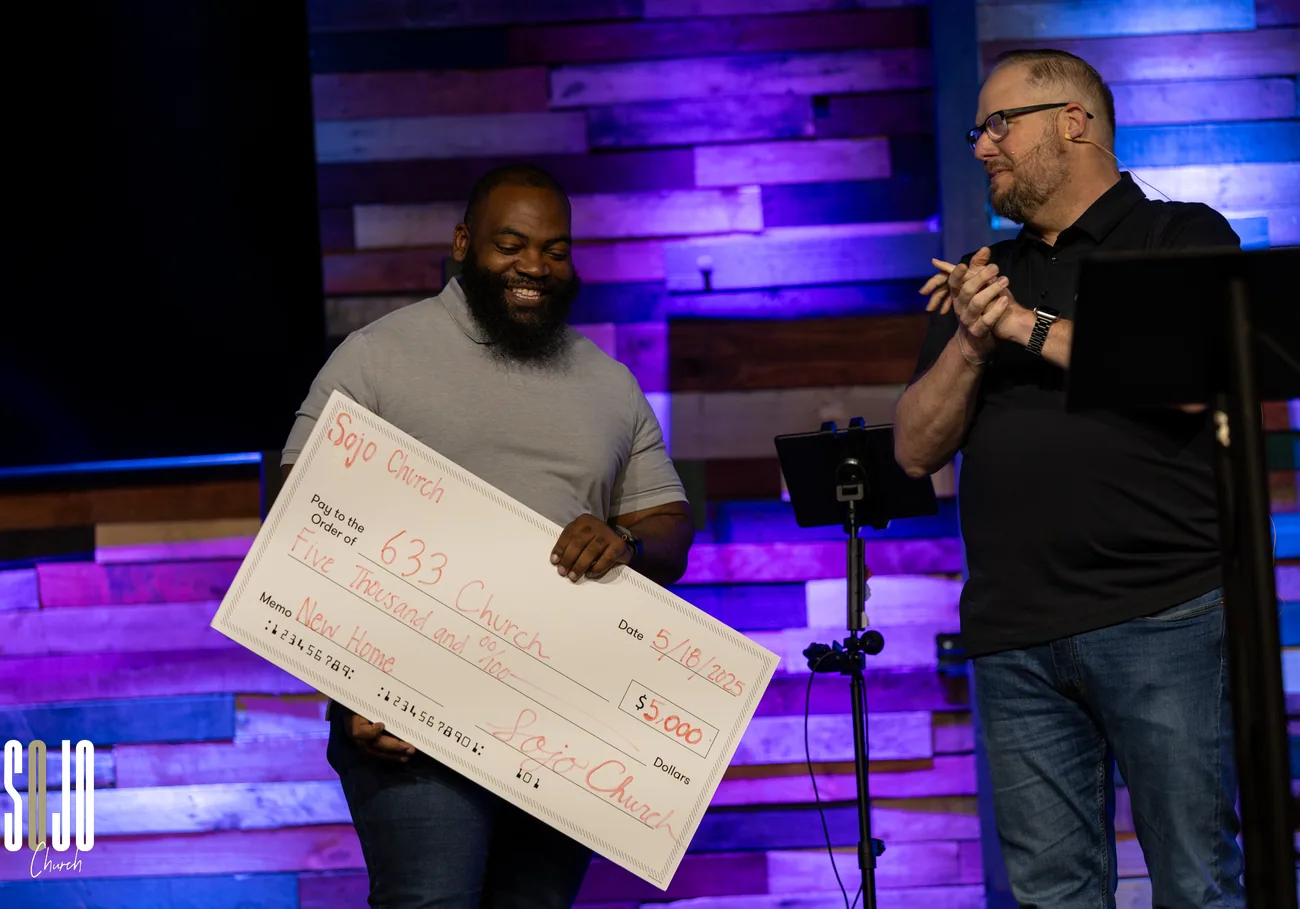
Generosity, handed to somebody who needed it
What giving is, biblically
Four words the
Bible actually uses
“Giving” is a flat English word for four different things in Scripture. They are not interchangeable, and knowing the difference takes a lot of the confusion out.
Firstfruits — giving off the top
“Honor the Lord with your wealth, with the firstfruits of all your crops” (Proverbs 3:9). Israel brought the first of the harvest, not the leftovers, before they knew how the rest of the season would go. Firstfruits is a statement about who you think provides.
The tithe — the first tenth
“A tenth of the produce of the land… belongs to the Lord; it is holy” (Leviticus 27:30). Abraham tithed before the Law existed (Genesis 14). Jacob pledged it before there was a temple (Genesis 28). Jesus assumed His hearers did it (Matthew 23:23). Ten percent is the historic starting line, not the finish line.
Offerings — giving beyond the tenth
The tabernacle and the temple were both funded by freewill offerings above the tithe (Exodus 35, 1 Chronicles 29). This is where generosity stops being obedience and starts being imagination.
Alms — giving straight to need
“Whoever is generous to the poor lends to the Lord” (Proverbs 19:17). Jesus assumed it: “when you give to the needy” (Matthew 6:2), not if. Some of your giving should never pass through an institution at all.
Two more things the New Testament makes plain: giving is worship, not transaction (Philippians 4:18 calls it “a fragrant offering”), and it is voluntary. “Each of you should give what you have decided in your heart to give, not reluctantly or under compulsion, for God loves a cheerful giver” (2 Corinthians 9:7). Nobody at SOJO is going to check your math.
Who gives — and how much
The honest
answer
Everyone who calls SOJO home. And if you are visiting, not you — you are our guest. Keep your wallet in your pocket.
Here is the part churches usually fumble. Giving is for followers of Jesus, because it is a discipleship practice, not a membership fee. If you are still figuring out what you believe, you are genuinely off the hook. Come, eat, ask hard questions, take your time.
For those who do follow Him, the New Testament never repeals the tithe and never turns it into a tax. It does something harder: it raises the bar and removes the ceiling. Paul's instruction is proportional (“in keeping with your income” — 1 Corinthians 16:2), planned, regular, and cheerful. The Macedonians in 2 Corinthians 8 gave beyond their means and had to beg for the privilege.
So the number we teach is ten percent, first, off the top — not as a law you'll be judged by, but as the historic benchmark that keeps generosity from drifting into whatever happens to be left over. Almost nobody starts there. That is completely fine. You are not behind; you are on a ladder.
The generosity ladder
Not giving anything
Acknowledge the invitation. That is a real step, and it counts.
Give something
Any amount. The first gift is the hardest one you will ever make and the most important.
Give regularly
Build the habit. Consistency forms you far more than size does.
Give a percentage
Commit to a set share of your income instead of whatever is left at the end of the month.
Give the full tithe
Ten percent, first. Trust Him with the first slice rather than the last.
Give beyond it
Sacrificially, on purpose, to bless people who cannot repay you.
Find the rung you are on. Take the next one. That is the entire strategy.

When to give
Rhythm beats
impulse
“On the first day of every week, each one of you should set aside a sum of money in keeping with your income” (1 Corinthians 16:2).
Notice what Paul builds in: a set day, a set proportion, and a decision made ahead of time instead of in the moment. Generosity that depends on how you feel on a given Sunday will always lose to whatever else came up that week.
First, not last. Firstfruits means the gift comes off the top, before the bills line up and make their case. If it waits until the end, it will not survive the month.
Weekly or per paycheck. Match the rhythm to how you actually get paid. Recurring giving is not laziness — it is a decision you only have to make once, honored automatically every time after.
Plus the unplanned. Keep room for the moment a need lands in front of you. Some of the best giving you ever do will never appear on a statement.
How to give
Five ways,
pick one
Online, one time or recurring
The simplest way and the one we recommend. Debit, credit, or bank draft. Set it and forget it, or give as you go.
In the Church Center app
Same giving, on your phone, alongside groups and event sign-ups. Search “Church Center” in your app store and find SOJO Church.
In the room on Sunday
Cash or check during the offering. Guests, this one is not for you.
Stock, crypto, or a donor-advised fund
Non-cash giving is tax-smart and often lets people give more than they thought possible without touching their bank account. Appreciated assets in particular can go further than cash.
Toward missions — here, near and far
Nineteen partners, funded every year — hunger and foster care in Concord, church plants from here to San Diego, and, through The Timothy Initiative, one new church planted every month. Every partner is named on the Outreach page.
Toward the new building
We are finishing out Gibson Mill — construction and outfitting both, with the permanent kids space and the coffee shop targeted for early 2027. If you want your giving pointed at the room our city walks into, say so.
Part two · Practicing Generosity
The 90-day
challenge
A discipleship journey into trust, freedom, and joy. Ninety days of learning to live with open hands before God.
This is not a fundraising campaign. It is an invitation to become more like Jesus.
Generosity is not something a few people happen to be naturally good at. It is something followers of Jesus practice — and practices are what form us. In Practicing the Way, John Mark Comer makes the case that spiritual practices shape who we are becoming. In The Treasure Principle, Randy Alcorn reframes money through an eternal lens: what we do with our resources reveals what we trust and love most.
Put those together and you get a simple, uncomfortable truth. Generosity is a practice that reorders the heart toward God and His Kingdom. When it becomes a practice, it stops being about pressure and starts being about freedom.
How the 90 days work
Four moves
Pray and ask the Lord
Before you pick a number, ask Him for one. This is the step people skip, and it is the step that makes the other three mean anything.
Read the book
The Treasure Principle by Randy Alcorn. We give a copy away free to everybody who signs up — it has helped millions of believers find the joy of an eternal perspective, and it is short enough to actually finish.
Take the challenge
Ninety days of consistent, intentional giving at the level God put in front of you. Long enough to become a rhythm instead of a mood.
See what generosity does
In you. Through you. Beyond you. Then decide what you want the next ninety days to look like.
Pick your starting line
Everyone’s journey
is different
The invitation is the same. The step is not.
Start giving
I want to begin trusting God through the practice of generosity. Whether it is your first gift ever or your first consistent one, every step of obedience matters.
Give my first gift →Increase my giving
I want to take another step toward becoming a tither. If you have been giving occasionally, this is the season to grow into consistency and move toward the first ten percent.
Increase my gift →Legacy giving
I want to give beyond the tithe. Having established the ten percent, I want to invest over and above it to expand God's Kingdom and leave something lasting.
Talk to us →We don’t give to a church. We give through one.
In me · Through me · Beyond me
Straight
answers
Is this about the church needing money?
No. This journey is about discipleship and trust, not pressure. If the only thing that changed in ninety days was our bank balance, we would consider it a failure.
What if I'm struggling financially?
Then generosity should never be fear-driven, and we mean that. If money is genuinely tight, we would rather pray with you and help you build a plan than take your last twenty dollars. Call or text us at 980-680-0958 — that conversation stays between us.
Why recurring giving?
Because it turns generosity into a steady practice instead of a sporadic action. You make the decision once, prayerfully, instead of re-litigating it every Sunday against whatever else came up that week.
Is generosity only about giving to the church?
No. Generosity is a way of life — your time, your table, your attention, your money. Giving through the church is one meaningful way we practice it together, and Scripture also calls us to give directly to people in need.
Where does my money actually go?
Ministry and staff, kids and students, outreach across Cabarrus County, and the building at Gibson Mill. If you want a detailed breakdown, ask — we will show you.
Can I designate my gift?
Yes. You can give toward general ministry or toward the new building specifically. Both options are in the online giving form.
Is my gift tax-deductible?
Yes. SOJO Church is a registered nonprofit and you will receive an annual giving statement. For anything involving stock, crypto, or a donor-advised fund, talk to your tax advisor — and talk to us, because we can usually make it simpler than you expect.